


By Revolead editorial · 8 min read
The practical answer is simple: run a buyer-prompt scan, find which competitors own the answers, fix the pages and proof gaps that make your brand hard to cite, then recheck the same prompts before you call it progress. AI visibility matters only when it connects to a clear offer, a credible conversion path, and sales pipeline evidence.
Key point: AI visibility only matters when buyer prompts, competitor ownership, source evidence, and the conversion path are measured together.
Key takeaways
- Measure buyer prompts before producing content; the prompt, not the keyword, is the operating unit.
- Track competitor answer ownership, citations, answer accuracy, and next-click quality, not mentions alone.
- Fix offer clarity, proof, comparison pages, and crawlable answer blocks before chasing broader content output.
- Recheck the same prompts and connect movement to demo requests, sales-call language, and pipeline quality.
The buyer problem: your shortlist may now be built before your site visit
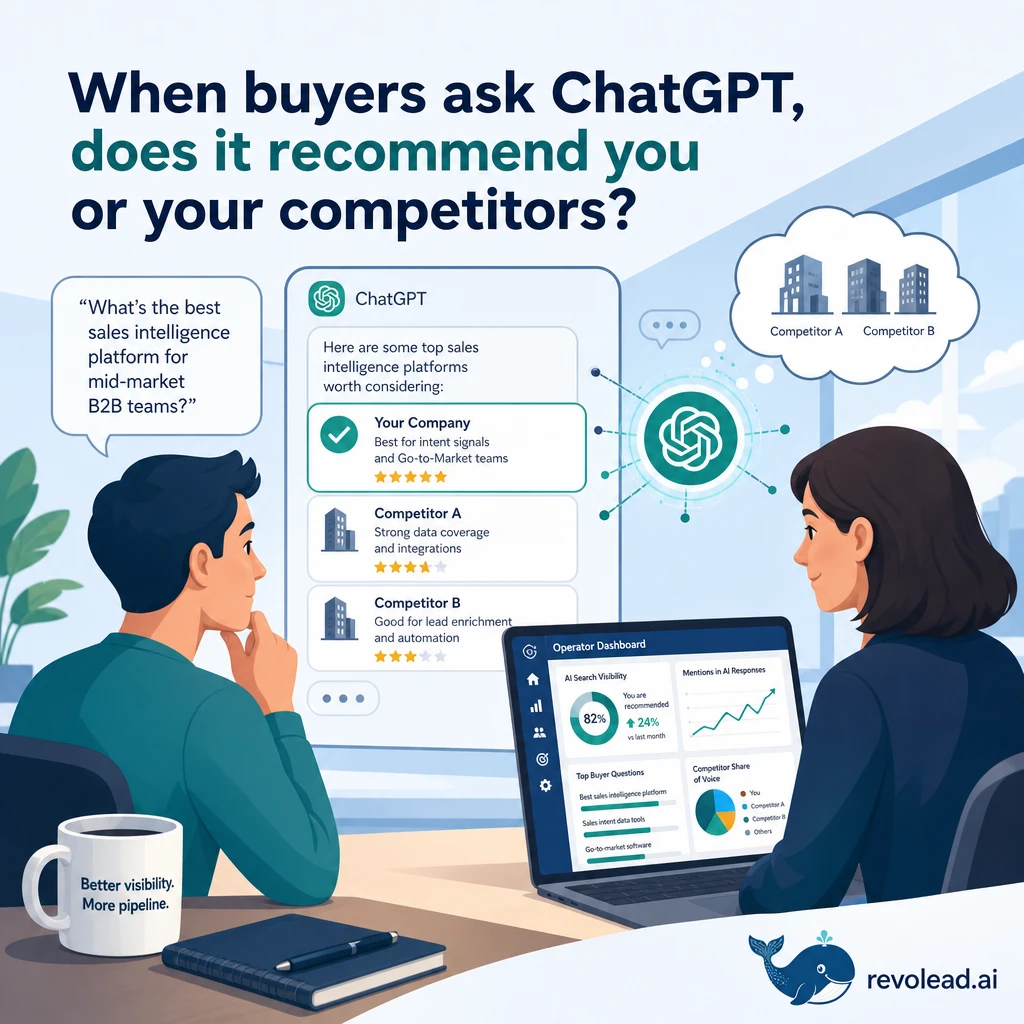
A buyer can now ask an AI system for a recommendation before they search your category, compare vendors, or visit your website. If the answer names two competitors and ignores you, your sales team may never see that demand.
The concrete answer is not to publish more generic content. The answer is to measure the exact questions buyers ask, record which brands are recommended, identify the sources the answer relies on, and repair the content, proof, entity, and conversion gaps that keep you out of the shortlist.
For operators, the unit of work is not a keyword. It is a buyer prompt with commercial intent: "best revenue operations platform for a 50-person B2B SaaS team," "ChatGPT vs Perplexity for market research workflows," or "which agency helps B2B companies get cited in AI answers."
Recommendation: treat AI answer visibility like a sales enablement problem. The question is not "do we rank?" The question is: when a buyer asks for a vendor, are we named, trusted, and easy to act on?
Proof: answer surfaces are now real distribution, not a side experiment
OpenAI says ChatGPT has more than 900M weekly active users and more than 50 million consumer subscribers. That does not prove your buyer uses ChatGPT for vendor selection, but it proves the interface is mainstream enough to deserve measurement.
OpenAI's own ChatGPT search launch says the product can provide fast answers with links to relevant web sources, and that chats include source links such as news articles and blog posts (OpenAI). That matters because a recommendation answer is not only generated text; it is often backed by pages, publications, comparison content, documentation, or public profiles.
Google says AI Overviews are available in more than 200 countries and territories and more than 40 languages. Google also says AI features in Search can use query fan-out, issuing related searches across subtopics and data sources before generating a response (Google Search Central).
Inference: buyers are getting fewer isolated blue-link journeys and more synthesized answers. Your company still needs classic SEO foundations, but the commercial risk has shifted. The buyer may form a vendor list inside the answer before they click any result.
What to measure: prompts, answer ownership, evidence, and pipeline path
An AI visibility scan should answer four operator questions. Which buyer prompts matter? Which brands are recommended? Which sources are used to justify those recommendations? Which recommended brands have the clearest path from answer to conversion?
Start with 25 to 50 prompts. Use sales calls, CRM notes, Google Search Console queries, customer emails, win-loss notes, and competitor comparison pages. Separate prompts by intent: problem diagnosis, category education, vendor shortlist, comparison, pricing, implementation, and local or vertical fit.
Then score answer ownership. A simple score is enough: brand mentioned, brand recommended, brand cited as a source, competitor mentioned, competitor recommended, source quality, answer accuracy, and next-click quality. The point is not mathematical perfection. The point is a baseline you can recheck after fixes.
Google states that to be eligible as a supporting link in AI Overviews or AI Mode, a page must be indexed and eligible for a Search snippet, with no additional technical requirements (Google Search Central). Google also says its Search index is well over 100,000,000 gigabytes in size. That explains why vague pages vanish: the system has too much material to choose from.
Recommendation: connect the scan to revenue operations. A prompt only matters if it maps to an offer, a page, a sales conversation, or a segment you actually want.
Worked example: a 30-day scan for a B2B workflow software company
Assumptions, not benchmarks: imagine a B2B workflow software company with an $18,000 average annual contract value, a clear implementation service, and three direct competitors. The company suspects prospects are asking ChatGPT and Google AI results for tool recommendations, but it has never measured the answer surface.
Day 1 to 3: collect 40 prompts. Ten come from sales calls, ten from Search Console queries, ten from competitor comparison pages, and ten from founder judgement. The prompts are split across category, pain, comparison, implementation, and pricing intent.
Day 4 to 7: run the same prompts across ChatGPT search, Google AI Overviews or AI Mode where available, Perplexity, and Claude web search where enabled. Anthropic's API documentation says Claude web search gives Claude direct access to real-time web content and that responses include citations for sources drawn from search results (Anthropic). That makes citation recording part of the scan, not an optional note.
Example baseline: the company is mentioned in 9 of 160 answer checks, recommended in 3, and cited as a source in 0. Competitor A is recommended in 34, Competitor B in 21, and Competitor C in 14. The common source pattern is simple: competitors have clearer comparison pages, named use cases, pricing explanations, integration pages, and third-party mentions.
Day 8 to 21: fix the highest-value gaps. Write one category page, two comparison pages, one implementation page, one proof page, and one FAQ built from real objections. Add visible author, date, sources, schema that matches the page, internal links, and a stronger call to book a sales conversation.
Day 22 to 30: recheck the same prompts. Do not claim pipeline from visibility alone. Look for movement in mentions, recommendations, citations, answer accuracy, assisted form fills, demo requests from affected pages, and sales calls where prospects mention AI research.
How to fix the gap: make the brand easier to understand, cite, and choose
The first fix is offer clarity. If your homepage says you transform operations with AI, the answer engine has no concrete category to attach to you. If your page says you help B2B SaaS teams turn AI-search gaps into qualified pipeline through a scan, fixes, and recheck loop, the system and the buyer have something usable.
The second fix is answer-shaped content. Put the direct answer near the top. Use headings that match the buyer's question. Define the category. Explain who the offer is for and who it is not for. Show the inputs, process, outputs, risks, and next step.
The third fix is evidence. Google advises creating unique, useful, non-commodity content based on first-hand knowledge and organizing it clearly for readers (Google Search Central). The GEO research paper reported visibility gains of up to 40% under experimental conditions, with effects varying by domain and method. Treat that as a research signal, not a guaranteed business result.
The fourth fix is source strategy. Your own site matters, but answer engines may lean on third-party pages, public profiles, documentation, reviews, media, community discussions, or comparison content. If competitors are cited because third parties describe them clearly and nobody describes you clearly, the fix may be external presence, not another blog post.
Revolead's operating pattern is built around this sequence: AI visibility scan, competitor answer ownership, fix pack, recheck loop, then sales pipeline review. The workflow is useful because each stage produces a decision. It does not ask the team to believe a dashboard. It asks whether the next buyer answer improved.
Common mistakes: treating AI SEO like content volume
Mistake one: optimizing for the platform instead of the buyer. If the prompt has no sales intent, winning it may create no commercial value. A founder should care more about five prompts that match late-stage buying questions than fifty prompts that attract students, vendors, or casual researchers.
Mistake two: chasing mentions without conversion. Being named in an answer is useful only if the buyer can land on a page that explains the offer, proves credibility, handles objections, and creates a next step. Visibility without a conversion path is reputation, not pipeline.
Mistake three: publishing thin comparison pages. Operators are often tempted to write "us vs them" pages that never admit tradeoffs. Buyers do not trust that. Answer engines also have better material to cite when a page says when the product fits, when it does not, and what criteria matter.
Mistake four: ignoring technical basics. If important content is hidden, blocked, slow, unindexed, or absent from the visible page text, answer systems have less reliable material to retrieve. Google's guidance is clear that crawling, index eligibility, snippets, internal links, textual content, page experience, and structured data consistency still matter for AI features in Search (Google Search Central).
Limits: what AI visibility cannot promise
AI answer behavior is probabilistic. The same platform can change results as models, indexes, location, personalization, freshness, and interface rules change. A responsible operator measures deltas, not guaranteed placement.
AI visibility also does not replace product-market fit, category clarity, proof, or sales follow-up. If the offer is unclear, the landing page is weak, or the sales motion cannot handle demand, answer visibility may increase attention without increasing revenue.
There is also a measurement limit. Google says Search Console includes sites appearing in AI features within the overall Search traffic performance report, but it does not hand operators a perfect prompt-by-prompt AI answer report (Google Search Central). ChatGPT, Claude, Perplexity, and Google each expose different levels of source visibility and repeatability.
Recommendation: use AI visibility as a leading indicator. Pair it with page-level analytics, CRM source notes, demo-request quality, sales-call language, and rechecked prompt baselines. The commercial question stays the same: are more qualified buyers arriving already educated and more ready to talk?
The operator cadence: scan, fix, recheck, pipeline review
Run the first scan before changing content. This prevents opinion-driven work. A baseline shows which prompts matter, who owns the answers, and which source patterns explain the gap.
Ship fixes in a narrow batch. Do not rewrite the whole website. Start with the prompt clusters where buyers show purchase intent and competitors are already winning. Usually that means category pages, comparison pages, implementation pages, proof pages, FAQs, and clearer internal links.
Recheck the same prompts after the pages are crawled, indexed, and visible. Keep the methodology stable enough to compare. Record mention rate, recommendation rate, citation rate, sentiment, answer accuracy, competitor ownership, and next-click path.
Then review pipeline. Ask sales whether prospects mention AI research. Check whether affected pages assisted demo requests or booked calls. Inspect whether the offer page converts. If answer movement improves but pipeline does not, the next fix is not more AI SEO. It is offer clarity, proof, CTA, sales follow-up, or market selection.
This is the business-first view. AI answer engines can influence who gets considered. They do not close the deal by themselves. The operator's job is to turn answer presence into a credible next step.
Author's note - I use this workflow because AI answers can look convincing while still sending no buyer to sales. The practical limit is blunt: AI visibility does not create pipeline unless the offer, proof, landing page, and conversion path are clear enough for a serious buyer to act.
Related reading
Frequently asked questions
How often should a B2B company run an AI visibility scan?
Run a baseline scan before major content work, then recheck every 30 days while fixes are active. For stable categories, a quarterly scan may be enough after the first improvement cycle. For fast-moving markets or competitive launches, use a smaller weekly prompt set for the highest-value buyer questions.
Should operators optimize for ChatGPT first or Google AI Overviews first?
Start with buyer behavior, not platform preference. If prospects mention ChatGPT in sales calls, scan ChatGPT search first. If your category is still driven by Google demand, keep Google SEO foundations strong and measure AI Overviews or AI Mode where they appear. The best program compares the platforms instead of assuming one source of truth.
What is the first fix if competitors are recommended and you are not?
Look for the simplest evidence gap first: unclear category positioning, missing comparison pages, weak proof, absent use-case pages, thin external presence, or blocked indexing. Fix the page and source pattern that already helps competitors win the answer, then recheck the same prompt set.
Sources
- Scaling AI for everyone
- Introducing ChatGPT search
- AI features and your website
- Optimizing your website for generative AI features on Google Search
- AI Overviews expand to over 200 countries and territories, more than 40 languages
- How Google Search organizes information
- Web search tool - Claude API docs
- GEO: Generative Engine Optimization
Next step
Want to know who owns the AI answers in your market? Revolead scans the buyer prompts, maps competitor answer ownership, ships the highest-value fixes, and rechecks movement against the same baseline. Book an AI visibility scan and connect the result to pipeline, not vanity reporting.